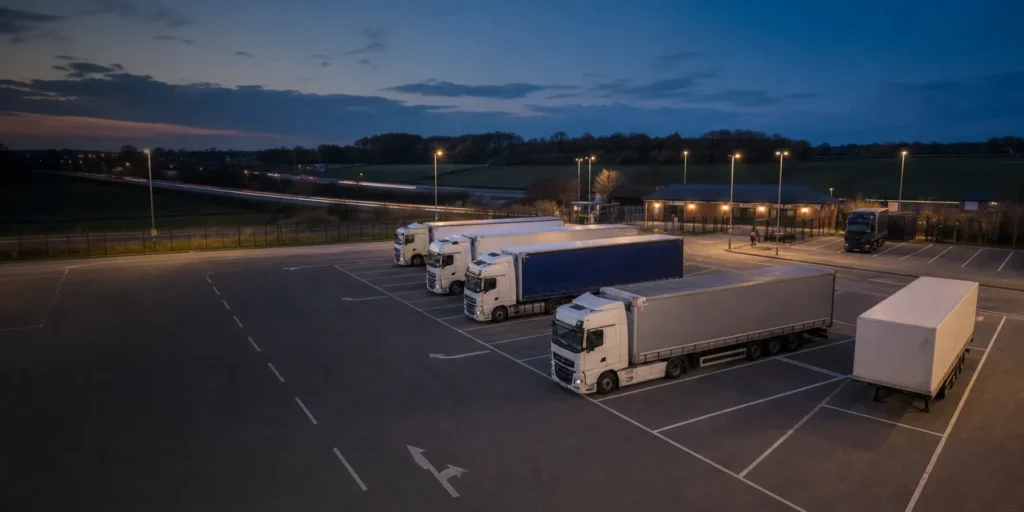
HGV and truck parking may be needed for a statutory break, an overnight stop, a vehicle awaiting a delivery slot, a trailer between jobs or longer-term operational parking. The right site depends on the vehicle, load, route and length of stay as well as the availability of spaces.
This page covers commercial vehicles, tractor units, trailers and coaches. It is not a public car-parking, airport-parking, caravan-storage or motorhome listing. TransportCompanies.co.uk connects users with independent parking providers. Each site sets its own acceptance rules, facilities, access controls, charges and terms.
Commercial vehicles a site may accept
Some sites accept complete articulated vehicles, rigids, tractor units, unaccompanied trailers, coaches or vans. Others are limited by bay length, surface, turning space, gate width or planning conditions. Tell the provider the complete combination length and whether the trailer will stay attached.
A loaded trailer is not the same risk as an empty unit. Declare high-value, refrigerated, hazardous, waste, food, livestock or out-of-gauge loads before booking. A provider may decline particular cargo or require additional information. Never assume that a general HGV space permits every load.
Location, access and booking
Give the town, motorway corridor, port, depot or distribution centre that the driver needs to reach. A site a few miles away may be unsuitable if access involves weight, height or time restrictions. Confirm arrival and departure windows, gate procedure, booking reference, number-plate requirements and whether the driver can re-enter after leaving.
Ask whether a space is reserved or subject to availability on arrival. For multi-day or regular use, agree the specific bays, access frequency, trailer movements and notice needed to change vehicle details.
Security measures and cargo responsibility
Terms such as “secure parking” can hide important differences. Ask what is actually present: perimeter treatment, lighting, controlled entry, CCTV, patrols, staffing and incident procedures. Confirm operating hours and whether monitoring is continuous. Facilities can reduce risk but cannot guarantee that theft, damage or interference will not occur.
Check the parking contract and the vehicle or cargo insurance requirements. Find out whether loaded or unattended trailers are accepted and whether keys must be retained by the driver or handed over. Parking charges do not automatically include insurance for the vehicle, trailer or cargo.
Driver welfare and on-site facilities
Toilets, showers, food, drinking water, rest areas, lighting and reliable access can materially affect whether a stop is practical. The Department for Transport’s guidance on lorry parks and driver welfare facilities describes the importance of suitable bays, lighting, security measures and welfare provision. That does not mean every listed site provides all of them.
For refrigerated trailers, ask whether an electrical connection is available, what plug and power arrangements apply, whether the unit may run on diesel, and who monitors it. Also ask about noise restrictions and fault reporting.
Information to include in a parking request
- Rigid, artic, tractor unit, trailer or coach, including total dimensions.
- Vehicle and trailer registration numbers where available.
- Loaded or empty status and a clear cargo description.
- Any ADR, high-value, temperature-controlled or abnormal-load details.
- Required location, arrival time, departure time and length of stay.
- Need for repeated access, trailer swapping or collection by another driver.
- Required welfare, power or operational facilities.
Parking charges and additional costs
Sites may charge per entry, night, day, week or month. Ask whether VAT, reservation, power, showers, overstays and repeated movements are extra. Cancellation or no-show terms may apply where a bay has been reserved.
Related services
If a parked trailer is needed for a new contract, compare commercial trailer hire. A vehicle that cannot leave under its own power may need HGV recovery, while defects identified before departure can be referred to a commercial vehicle workshop.
Need quotes for this service?
Tell us what you need, where the job is and any timing or handling details. We'll route your request to suitable transport companies.
