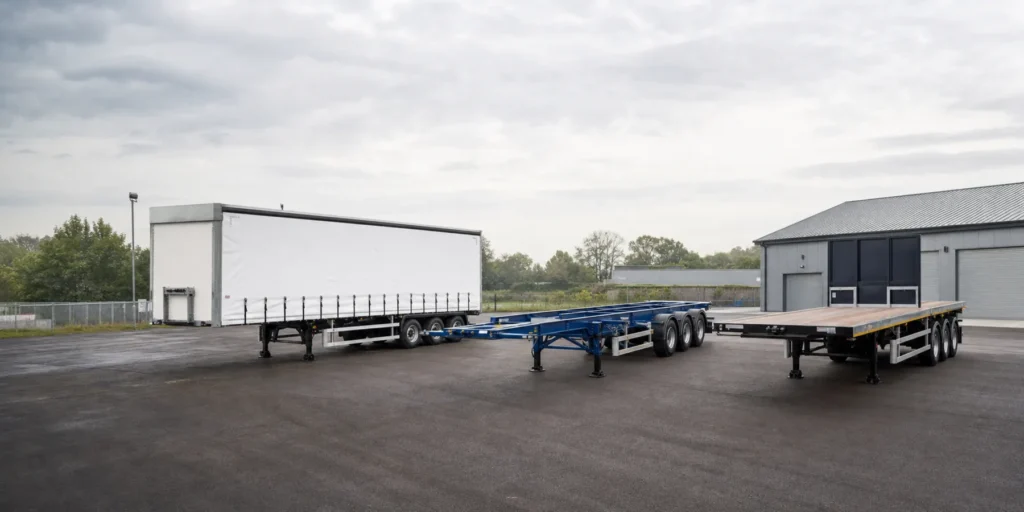
Commercial trailer hire can cover a planned fleet peak, a contract start, seasonal demand, workshop downtime or a one-off requirement for equipment that an operator does not keep permanently. Hire may be offered for days, weeks, months or longer, but stock, collection points, specifications and terms vary between providers.
This page is for road-haulage trailers, where some providers also offer tractor-unit hire. It is not for camping trailers, horseboxes, small domestic trailers or DIY house moves. TransportCompanies.co.uk introduces buyers to independent providers. The provider remains responsible for its offer and the hirer must confirm suitability, roadworthiness arrangements, insurance, operator-licensing implications and contractual responsibilities before use.
Types of commercial trailer available for hire
Providers may offer curtainsiders, box trailers, flatbeds, skeletal or sliding container trailers, refrigerated trailers, tippers, low loaders and specialist equipment. A generic request for “a 44-foot trailer” is rarely enough: body type, deck height, axle configuration, coupling, load, payload, internal dimensions and ancillary equipment can all change whether a unit is suitable.
- Curtainsider and box trailers: general palletised and protected freight.
- Skeletal trailers: ISO containers, subject to the required container size and configuration.
- Flatbeds: machinery, steel, timber and loads needing side or overhead access.
- Refrigerated trailers: temperature-controlled work with agreed set point, power and monitoring capability.
- Low loaders and specialist trailers: plant or abnormal loads requiring detailed weight, height and route planning.
Short-term, spot and contract hire
Spot hire can cover a short operational gap, while longer hire may give an operator dedicated equipment for a contract. Ask whether the quoted period has a minimum term, what happens if the unit is returned early or late, and whether extension is possible. Do not assume an advertised model is available at every depot or on the required date.
Collection and return inspections should record condition, tyres, fittings and supplied equipment. Agree where collection and return take place, permitted use, mileage or geographic limits where relevant, servicing arrangements, breakdown reporting and cleaning expectations.
Roadworthiness and operator responsibilities
Hiring equipment does not transfer every operating responsibility to the owner. The DVSA Guide to Maintaining Roadworthiness covers hired, loaned and leased vehicles as well as trailers. The hirer should understand who schedules maintenance and safety inspections, who keeps records, how defects are reported and what evidence must be available.
Drivers still need the appropriate entitlement and must complete the required vehicle and trailer checks. Coupling, brakes, tyres, lights, body condition and load security cannot be assumed from the fact that a trailer has just been collected.
Insurance, damage and breakdown terms
Ask what insurance the hirer must arrange, what damage waiver or excess applies and who is responsible for tyres, glass, misuse, recovery and loss of use. Confirm the breakdown contact and what support is included. A maintenance package does not automatically cover damage, driver error or unsuitable loading.
If hired equipment fails, a provider may arrange repair, replacement or recovery under its terms. For separate help, compare commercial vehicle repair or HGV recovery providers.
Information to include in a trailer hire request
- Trailer type, body, length, height, axle and coupling requirements.
- Cargo description, package method, maximum load and any ADR or temperature needs.
- Collection location, operating area and return location.
- Required start date, duration and likely extension needs.
- Tractor unit details and whether delivery or collection is required.
- Ancillary equipment such as tail lift, straps, twist locks or refrigeration.
- Insurance position and the legal entity entering the hire agreement.
Charges to compare
Compare the base daily, weekly or monthly rate alongside deposit, delivery, collection, mileage, maintenance, cleaning, damage, late-return and cancellation terms. VAT should be clear. Where tractor units are hired, fuel arrangements should also be clear. The cheapest headline rate is not necessarily the lowest total cost if the collection point, specification or included support is unsuitable.
Related commercial vehicle services
Operators holding equipment between jobs can compare HGV and truck parking. For a complete transport movement rather than equipment-only hire, request support through general haulage or container transport.
Need quotes for this service?
Tell us what you need, where the job is and any timing or handling details. We'll route your request to suitable transport companies.
