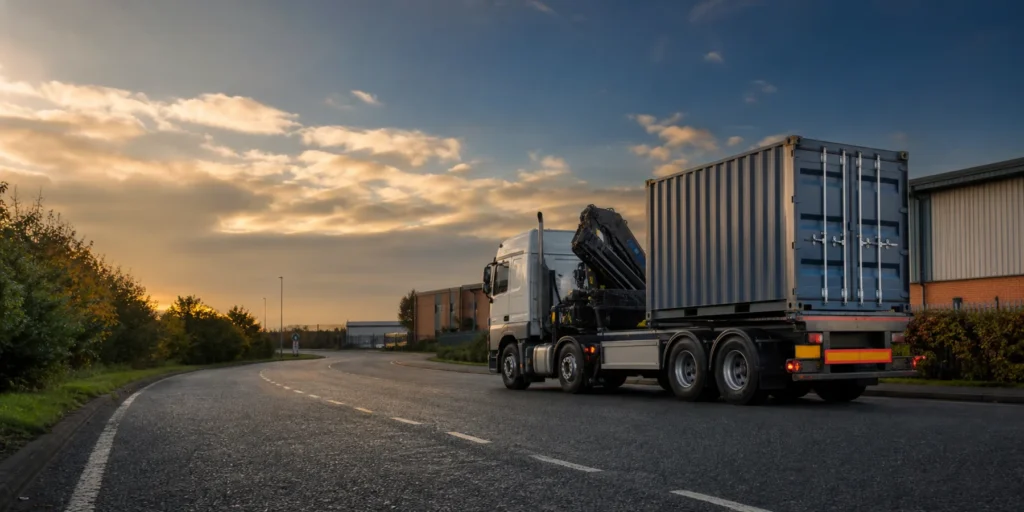
A shipping container moving service collects an existing or newly purchased container, transports it by road and delivers it to another non-port site. Buyers use it to relocate storage containers, site units, workshop boxes and other static containers between yards, farms, construction sites and commercial premises.
This is different from import or export container transport from a port, rail terminal or shipping-line depot. It is also different from booking a standalone lift. TransportCompanies.co.uk routes requests to suitable third-party providers; the chosen company must confirm the vehicle, lifting method, route, placement and insurance for the specific move.
What a container moving service can cover
A combined move can include collection, loading, road transport, delivery and agreed placement. Many jobs use a crane-equipped vehicle, often described as a HIAB container transport service. Others use a sidelifter, flatbed or separate crane at one or both ends. The method depends on weight, reach and access, not simply the container length.
- Moving an empty 10ft, 20ft or 40ft storage container.
- Collecting a container purchased from a dealer or another business.
- Relocating a site office, workshop or welfare container.
- Moving a box between commercial yards or project sites.
- Delivering and placing the container in an agreed orientation.
Empty, loaded and converted containers
Do not describe a container as empty if it contains racking, tools, stock, liquids or fixed equipment. Even a small load changes the gross weight and may move during lifting or braking. Providers may require the unit to be completely empty, or they may accept a loaded or converted container only after detailed assessment.
Converted units need their dimensions, weight and structural changes declared. Doors, windows, insulation, internal fit-out, roof equipment and added lifting points can affect how the unit is handled. A standard external length does not prove that a converted box can be lifted like an unmodified freight container.
Collection and delivery access
The provider needs usable access at both ends. Give road width, gate measurements, turning space, gradients, surface type and any weight restrictions. At the placement point, identify soft ground, drains, chambers, underground services, buildings, trees and overhead cables. A crane vehicle also needs room for outriggers and a safe lifting zone.
Say which way the doors must face and how far the final position is from the vehicle. “Put it behind the building” is not enough for a quote. Measured plans, photographs and a site contact reduce the chance of a failed delivery.
Route, permits and timing
Most standard empty-container moves can use conventional routes, but converted, over-height, over-width or heavy units may require different equipment and route checks. The provider must confirm the legal vehicle and axle limits, load security and any notice or permit requirements. Do not book site labour around an unconfirmed arrival time.
Lifting and placement
If a lorry-mounted crane is proposed, its capacity depends on the working radius and setup. A container that can be lifted close to the vehicle may not be liftable over a wall or across a wide verge. The HSE’s lifting operations guidance explains the need for competent planning, supervision and safe execution.
Where you only need a load, offload or repositioning operation with no road move, request container lifting instead.
What affects the price?
Price is shaped by mileage, vehicle and crane size, container weight, lifting radius, access at both sites, waiting time, route restrictions and whether another visit or separate crane is required. It can also change if the container is not ready, the site cannot receive the vehicle or the declared weight is wrong.
Information to include in your request
- Collection and delivery addresses and site contacts.
- Container size, type, ownership, condition and modifications.
- Confirmation that it is empty, or full details and weight of contents.
- Best available gross weight.
- Vehicle access, ground and overhead restrictions at both ends.
- Lifting reach and final placement position.
- Preferred dates and any booking, induction or permit requirements.
Need quotes for this service?
Tell us what you need, where the job is and any timing or handling details. We'll route your request to suitable transport companies.
