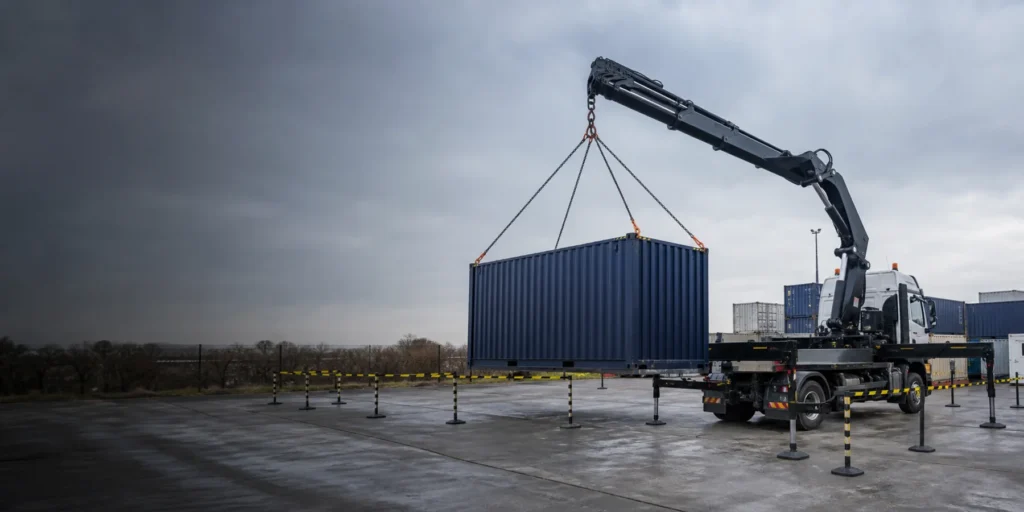
Container lifting is a standalone operation to load, offload, reposition or place a shipping container at a depot, yard, factory or commercial site. The correct method depends on the container, its actual weight, the available lifting points, the distance from the vehicle or crane to the placement position, ground conditions and overhead restrictions.
TransportCompanies.co.uk connects buyers with suitable third-party providers. It does not plan or carry out the lift. The appointed provider must assess the job, select suitable equipment and agree who is responsible for planning, supervision, exclusion zones and site control.
Container lifting methods
A lorry-mounted loader crane, often called a HIAB, can be suitable when the container is within the machine’s capacity and the vehicle can reach a firm, level working position. Other jobs may need a mobile crane, reach stacker, sidelifter or separate lifting and transport equipment. Photographs alone are not enough to determine the lifting method safely.
- Loading a container onto a suitable vehicle.
- Offloading a delivered container onto prepared ground.
- Repositioning a container within a commercial site.
- Placing a container where the crane must work at a stated radius.
- Depot lifts using a spreader-equipped reach stacker.
If you need collection, road transport and delivery as one job, use the shipping container moving service page. This page is deliberately limited to the lift itself.
Weight and container condition
State whether the container is empty or loaded and give the best available gross weight. The lifting capacity shown for a crane changes with reach, configuration and site conditions, so a headline crane capacity cannot be applied at every radius. Loaded containers also raise questions about cargo movement, centre of gravity and whether the load was packed for lifting.
The provider will need to confirm suitable lifting points and accessories. Damaged corner castings, corrosion, modifications or an uncertain structure can change the method or stop the lift. Do not attach improvised eyes or ask a provider to lift from parts of the container that were not designed for it.
Access, ground and overhead hazards
The vehicle or crane needs enough room to enter, turn, deploy outriggers and leave without trapping other traffic. Give the surface type, gradients, soft ground, underground services, drains, chambers, kerbs and any limits on axle loading. Photographs from several angles and measured distances are useful.
Record overhead cables, trees, canopies, lighting columns and nearby buildings. The final position should be prepared and level, with enough space to open the doors if required. Members of the public and unrelated workers must be kept out of the lifting area.
Planning and responsibility
The Health and Safety Executive states that lifting operations involving lifting equipment must be properly planned by a competent person, appropriately supervised and carried out safely. Its lifting-operation planning guidance explains that more complex work needs planning suited to the risk.
Ask whether the quote is for equipment and an operator under your organisation’s lift plan, or for a contract lift where defined planning and control responsibilities are accepted by the lifting company. Never assume the commercial label: get the responsibilities in writing.
What to include in a container lifting request
- Exact lift address and proposed date.
- Container size, type, condition and empty or loaded status.
- Actual gross weight where known, or the best available estimate, and cargo details.
- Required operation: load, offload, reposition or final placement.
- Measured reach, height difference and placement orientation.
- Access width, turning space, ground and outrigger area.
- Overhead restrictions, nearby buildings and site rules.
- Photographs, plans and contact details for the site representative.
Need quotes for this service?
Tell us what you need, where the job is and any timing or handling details. We'll route your request to suitable transport companies.
